Sep 4, 2026Al Learning Center
AI Wireless Ultrasound for Medical Training | COSDA
Learn how AI wireless ultrasound can support medical training, anatomy recognition and hands-on scanning practice for students and training centers.
AI Wireless Ultrasound for Medical Training: Can It Help Beginners Learn Scanning Faster?
Learning ultrasound is not only about understanding anatomy.
For beginners, one of the biggest challenges is knowing where to place the probe, what they are looking at, and whether they are scanning the correct anatomical region.
This is one reason AI-assisted wireless ultrasound is attracting attention from medical schools, ultrasound training centers, teaching hospitals, and other institutions involved in clinical education.
But what can AI actually contribute to ultrasound training?
And should a medical education program consider AI when choosing a wireless ultrasound system?
Why Ultrasound Can Be Difficult for Beginners
Ultrasound is highly operator-dependent.
Unlike imaging methods where image acquisition is largely controlled by the equipment, ultrasound requires the operator to actively position and move the probe to obtain useful images.
A beginner must learn several skills at the same time:
- how to position and orient the probe;
- how to recognize anatomical structures on an ultrasound image;
- how to adjust the scanning position when the expected anatomy is not visible;
- how different probe movements change the image;
- and how to connect what appears on the screen with real human anatomy.
This learning process normally requires repeated hands-on practice and instructor guidance.
For medical schools with many students, that can create a practical challenge: how can more students receive meaningful scanning practice without requiring an instructor to guide every probe movement?
Where AI Can Help in Ultrasound Training
The term “AI ultrasound” can mean very different things depending on the manufacturer and system.
Some ultrasound platforms use artificial intelligence for automated measurements or image analysis. Others focus on workflow assistance, anatomy recognition, or scanning guidance.
For education, the second approach can be particularly useful.
Instead of trying to replace the instructor or make a diagnosis for the student, AI can act as an additional learning aid during scanning.
For example, anatomy-recognition functions may help beginners understand whether they are scanning the intended region.
This creates a simple learning loop:
Scan → Observe → Recognize → Adjust → Scan again
The student still needs to learn probe handling and image interpretation, but AI can provide an additional reference during practice.
What AI Means in COSDA Wireless Ultrasound
At COSDA, AI is designed as an optional assistance tool for learning and scanning, rather than a replacement for clinical judgment or professional ultrasound training.
The current optional AI package supports recognition of seven anatomical regions.
For learners, this can provide an additional reference while practicing different scanning areas.
The purpose is not to tell a student that they have made a diagnosis.
Instead, the system is intended to help users become more familiar with the relationship between:
probe position → scanning region → ultrasound image
This distinction is important when medical schools or distributors evaluate AI ultrasound products.
A useful question is not simply:
“Does this ultrasound have AI?”
A better question is:
“What exactly does the AI help the user do?”
Why Wireless Ultrasound Fits Medical Education
AI is only one part of the training experience.
The physical design of the ultrasound system also matters.
Traditional cart-based ultrasound systems are essential in many clinical departments, but they are not always the most convenient option when a school wants multiple students practicing at the same time.
Wireless handheld ultrasound changes the training setup.
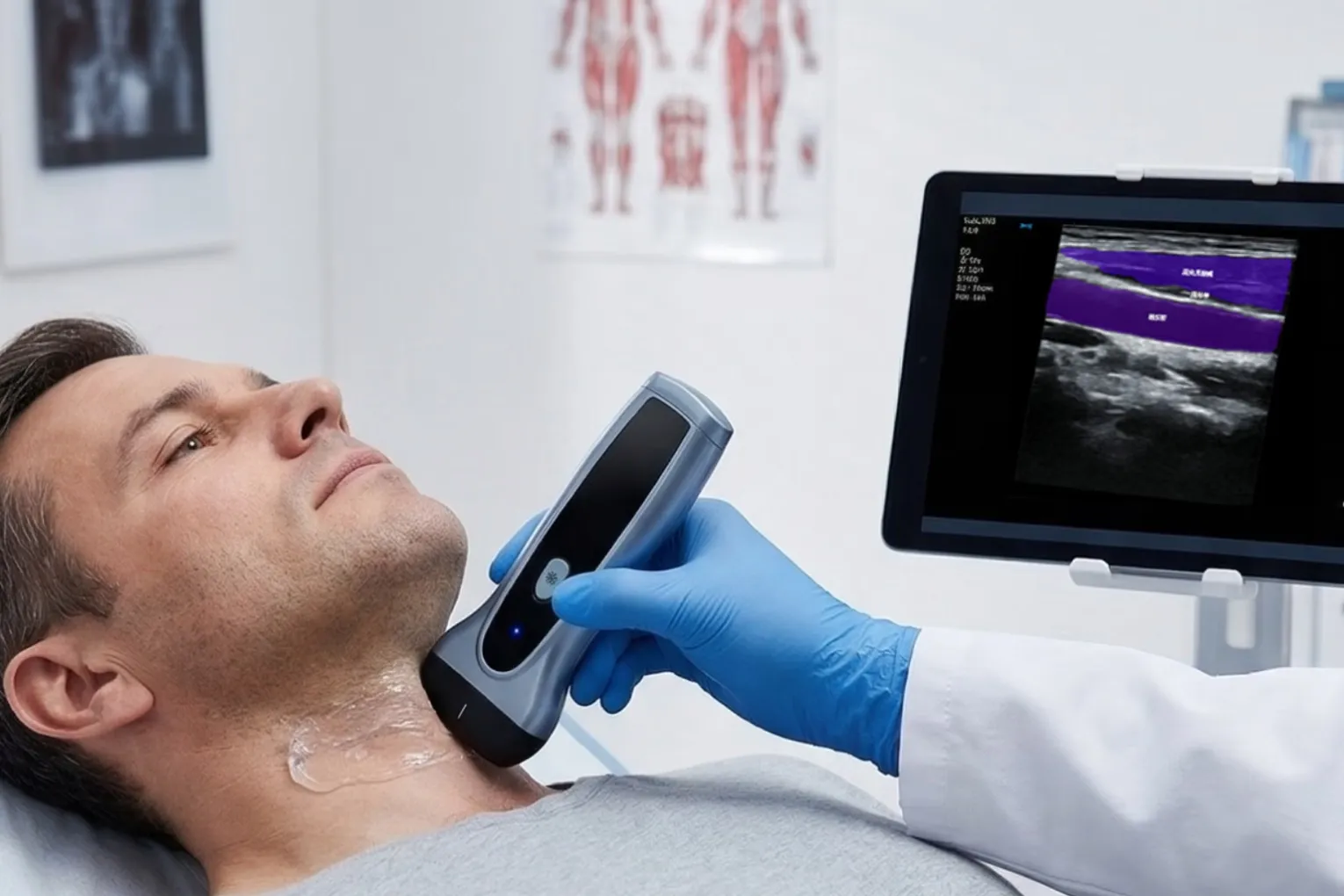
A compact probe can be paired with a compatible smart device, making it easier to organize scanning practice in classrooms, skills labs, workshops, or other training environments.
Students can focus on the basic scanning process without always needing access to a full-size ultrasound system.
For institutions planning to expand hands-on ultrasound education, portability can therefore be just as important as AI.
AI + Wireless Ultrasound: Why the Combination Matters
This is where the two technologies become more interesting together.
Wireless ultrasound improves access to scanning practice.
AI assistance can provide additional guidance during that practice.
For a medical education program, the potential value is therefore not simply owning an “AI ultrasound machine.”
It is creating a training environment where students can get more opportunities to pick up a probe, scan, observe anatomy, and gradually build confidence.
That may be especially relevant for:
- medical schools introducing ultrasound into undergraduate education;
- ultrasound training centers;
- teaching hospitals;
- clinical skills laboratories;
- workshops and continuing medical education programs;
- distributors developing the medical education market.
Can AI Replace an Ultrasound Instructor?
No.
AI-assisted ultrasound should not be treated as a substitute for qualified instructors, structured training, or clinical supervision.
An experienced instructor does much more than identify an anatomical region.
They teach probe technique, image optimization, anatomy, clinical context, interpretation, and scanning habits.
AI can support parts of the learning process, but the educational objective should remain the same:
help the learner develop real ultrasound scanning skills.
This is why COSDA positions AI as an assistance feature rather than an automated replacement for professional expertise.
Questions to Ask Before Buying AI Wireless Ultrasound for Training
If you are evaluating an AI wireless ultrasound system for a university, training center, or distribution project, do not compare products based only on whether “AI” appears in the specification sheet.
Ask the supplier:
What does the AI actually recognize or assist with?
Is it anatomy recognition, measurement, image optimization, scanning guidance, or something else?
Which anatomical regions are supported?
AI capabilities can vary considerably between systems.
Is AI included or optional?
This affects both initial purchasing decisions and product positioning.
Does the AI require an ongoing subscription?
Some systems may use different software licensing models, so long-term costs should be understood before purchasing.
What devices can the wireless probe work with?
For education projects, device compatibility can affect deployment across classrooms and training groups.
Is the system intended for education, clinical use, or both?
The answer should match the intended application and applicable regulatory requirements in your market.
Think Beyond the Price of One Ultrasound Probe
For educational buyers, evaluating wireless ultrasound only by unit price can be misleading.
A better question is:
How will the system actually be used by students?
Consider the number of learners, available instructors, training locations, compatible devices, AI requirements, and how many scanning stations the program wants to create.
For example, a school planning a small demonstration setup may have very different requirements from a university planning multiple student practice groups.
For distributors, understanding these details is also important.
Selling to the education market is not simply about offering another ultrasound probe. It is about helping the customer build a workable ultrasound training solution.
Is AI Wireless Ultrasound Worth Considering for Medical Training?
For institutions that want to expand hands-on ultrasound education, AI-assisted wireless ultrasound can be worth considering.
Its value does not come from AI alone.
The more important combination is:
portable hardware + accessible scanning practice + appropriate AI assistance + structured teaching.
When these elements work together, students can have more opportunities to practice and develop familiarity with ultrasound scanning.
AI should support that learning process—not replace it.
Looking for an AI Wireless Ultrasound Solution for Medical Education?
COSDA provides wireless ultrasound solutions for different application and training requirements.
For customers interested in AI-assisted learning, an optional AI package supporting recognition of seven anatomical regions is available on applicable configurations.
If you are a medical school, ultrasound training center, teaching institution, or distributor, tell us about your project, including:
- intended training application;
- number of students or users;
- required probe configuration;
- target market or country;
- and whether AI assistance is required.
This helps our team recommend a more suitable configuration for your project.
Contact COSDA to discuss your AI wireless ultrasound training requirements.