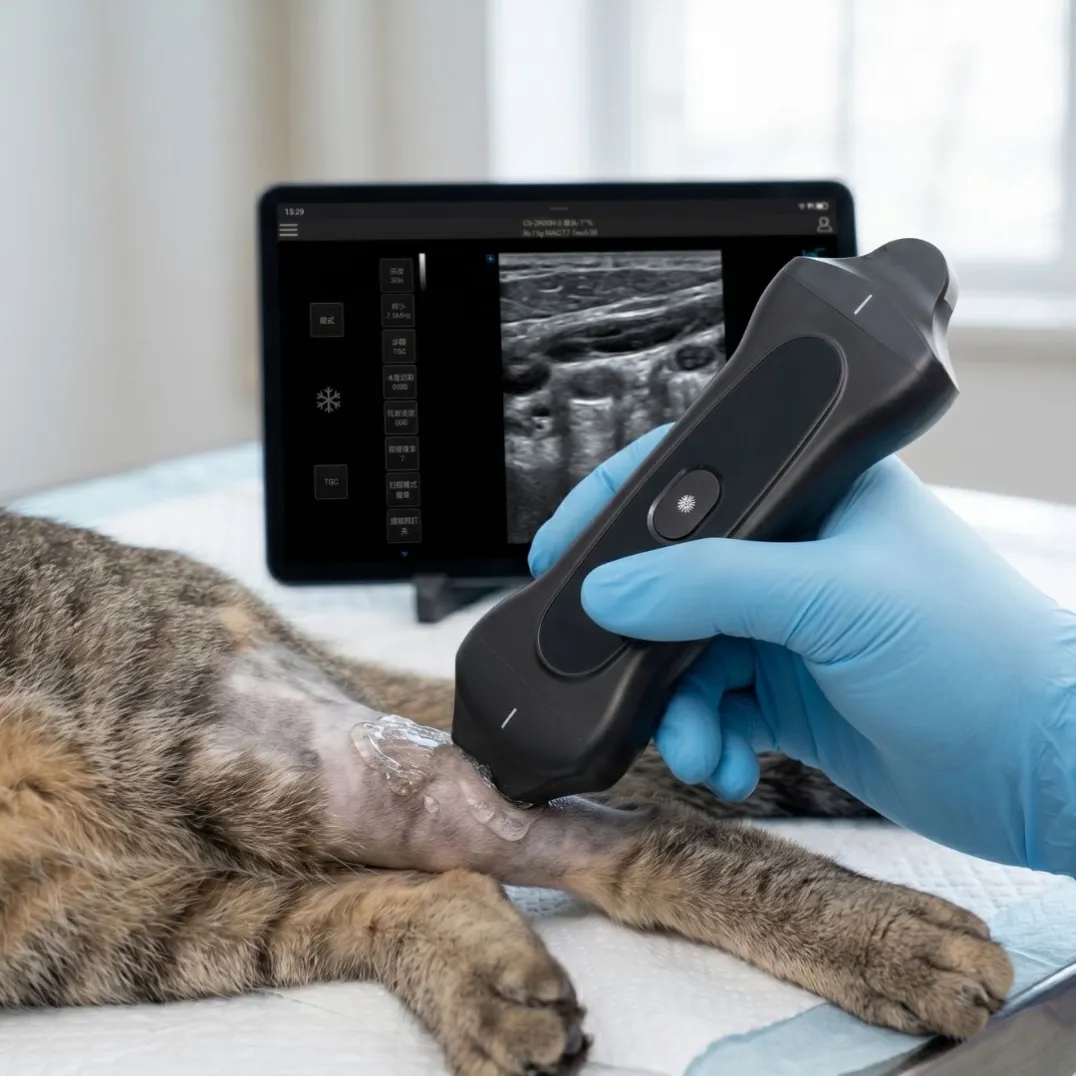
Sep 5, 2026Buying Guides
How Much Does a Veterinary Ultrasound Machine Cost?
Veterinary ultrasound machines run from about $1,000 entry handhelds to $50,000+ professional systems. See the 2026 price tiers, cost drivers, and hidden fees buyers miss.
Veterinary ultrasound machines cost anywhere from about $1,000 for an entry handheld scanner to $50,000 and beyond for a full professional system — a thirty-fold spread that makes "how much is it?" impossible to answer honestly with a single number. The useful answer is a price map: what each tier buys, what pushes a machine up or down in cost, and the hidden line items that decide whether your actual invoice matches the sticker. This guide gives you all three, with current market prices checked in September 2026, and where our own range fits.
If you are a veterinarian, clinic owner, or distributor pricing equipment for practice or resale in the Americas, this is written for you. If you are shopping for a personal "home ultrasound" gadget, clinical certification requirements will rule most of what follows out anyway.
Why Veterinary Ultrasound Prices Vary Thirty-Fold
- The buyer asks three vendors for "a cattle ultrasound" and receives quotes for three different instrument classes.
- The cheapest quote scans adequately on a calm dog in a quiet room — and falls apart on a.field pregnancy check at depth.
- Nobody compared the probe specifications behind each quote, because the quotes listed consoles, not transducers.
- The team re-quotes, waits, and the purchase slips past the season when the equipment would have paid for itself.
- The final bill grows past the sticker once training, spare probes, and shipping duties appear.
- You can hold all of this together by pricing in tiers first, and only then comparing machines within the tier that matches your caseload.
The Four Price Tiers (September 2026 Market)
Tier | Typical range | What you actually get | Sourced examples |
|---|---|---|---|
Entry handheld | ~$1,000–4,000 | Wireless or basic handheld scanners, B-mode plus limited Doppler; fine for companion-animal and basic field work | Basic portable vet units run $1,000–5,000 per BXLVet's pricing guide; KeeboVet lists a handheld vet scanner at $3,999 |
Mid-range laptop systems | ~$5,000–14,000 | Laptop consoles with full Doppler, multiple probes, adequate for regular bovine/equine pregnancy programs | Wellue lists laptop veterinary ultrasound from $1,599; dedicated bovine/equine units from $9,999 at VeterinaryUltrasounds.com |
Professional full-featured | ~$14,500–50,000+ | Hospital-grade consoles, advanced modalities, service contracts | Strata Imaging's buyer's guide puts full-featured veterinary systems at $14,500–50,000+ |
Brand-name cart systems | from $25,000 | Cart-based hospital platforms from major brands | GE Versana Active listed at $24,000; SonoSite Edge II at $25,000 (UDS) |
Two honest readings of that table. First, the jump from tier two to tier three buys modality depth and service infrastructure, not a magic image — a well-specified $8,000 laptop system routinely outscans a neglected $20,000 console on the exams most practices actually do. Second, prices move with configuration: the same console quoted with two probes versus five probes can differ by thousands.
Where Our Range Fits
COSDA manufactures portable ultrasound in its own factory, and our veterinary-capable line — wireless handheld scanners, wireless probes, and laptop color Doppler systems — spans roughly $1,000 to $10,000 depending on model, which covers the entry and mid-range tiers in the table above. We do not build $30,000 cart systems, and we will tell you when a tender requires one.
Three purchasing terms that matter to buyers and distributors:
- Low MOQ: a single unit is fine. Clinics can buy one machine direct; you do not need to be a distributor to order.
- OEM branding from 10 units. At ten units and above, we apply your brand to the hardware — the same line our distributor partners resell under their own labels.
- Certification paperwork ships with the order. Our products are CE-certified and we hold FDA registration and ISO certification; ask for the certificates for the exact model.
What Pushes the Price Up (or Keeps It Down)
- Probe count and type. Probes are the real cost drivers — a multi-frequency lineup (convex plus linear plus phased) adds more than any console feature. Our wireless handhelds publish 192-element arrays with convex, linear, and phased bands in one unit, which is one way the entry tier covers more caseload than it used to.
- Imaging modes. B-mode is baseline; color flow, PW Doppler, and power Doppler (B/CF/PW/PDI/DPDI on our systems) move a machine into vascular and cardiac questions.
- Software packages and language. Department software (our probe line ships ten packages, abdomen through cranium) and multilingual interfaces cost development money — and save yours if you serve a mixed-language market.
- Certification. Legitimate FDA/CE documentation costs money up front and prevents costs later.
The Hidden Costs Buyers Miss
- Training and ramp-up. Ultrasound is operator-dependent; ask whether training is included and delivered how.
- Spare probes. A dropped probe is the most common post-purchase expense; price a spare into year one for field-heavy practices.
- Shipping and duties. FOB prices exclude freight and import duties — ask suppliers to state terms explicitly, and get the machine's weight (our laptop unit is 5.5 kg) into the freight quote.
- Subscription creep. Some vendors meter AI features or software by the year. Our AI-assist option, where fitted, is a one-time addition — and you should ask every vendor to state their position in writing, because an annual fee quietly inverts a cheap sticker price by year three.
Three Questions Buyers Ask Before Ordering
Is an entry-level veterinary ultrasound actually usable, or a toy? Judge it by the specification lines that matter: element count, published frequency bands, and Doppler modes. A modern handheld with a 192-element array, convex plus linear bands, and B/CF/PW/PDI/DPDI modes is a genuine diagnostic instrument at the bottom of the price table — what the low tier buys today is dramatically more than it did three years ago. The honest limit is depth and session length, not capability.
Do quoted prices usually include probes, training, and shipping? Rarely all three. Console quotes often include one or two probes with more sold separately; FOB prices exclude freight and duties; training varies by vendor. That is exactly why the hidden-costs list above exists — make every vendor state all three in writing, and compare total year-one cost instead of sticker price.
Can I buy one machine, or do I need distributor volume? On our line, a single unit is fine — clinics order direct at low MOQ, and OEM branding starts at 10 units for partners who want their own label. Vendor policies vary widely here; put the question in your first email so it never surprises you at the checkout.
How to Get an Accurate Quote
A quote is only as accurate as the inputs behind it. Before you contact any supplier — us included — write down:
- Your species mix and the exams you run weekly.
- The probes and modes you believe you need (or the caseload, and let the supplier propose them).
- Quantity and timeline — single unit now, or a phased fleet.
- Your market, so certification and language requirements are right the first time.
- Any branding requirements (OEM from 10 units on our line).
Send those five lines through our contact page and the quote you get back will be a configuration, not a guess — and if the honest answer is that a $1,000 handheld covers your caseload, we will say so instead of upselling you into the mid-tier.